
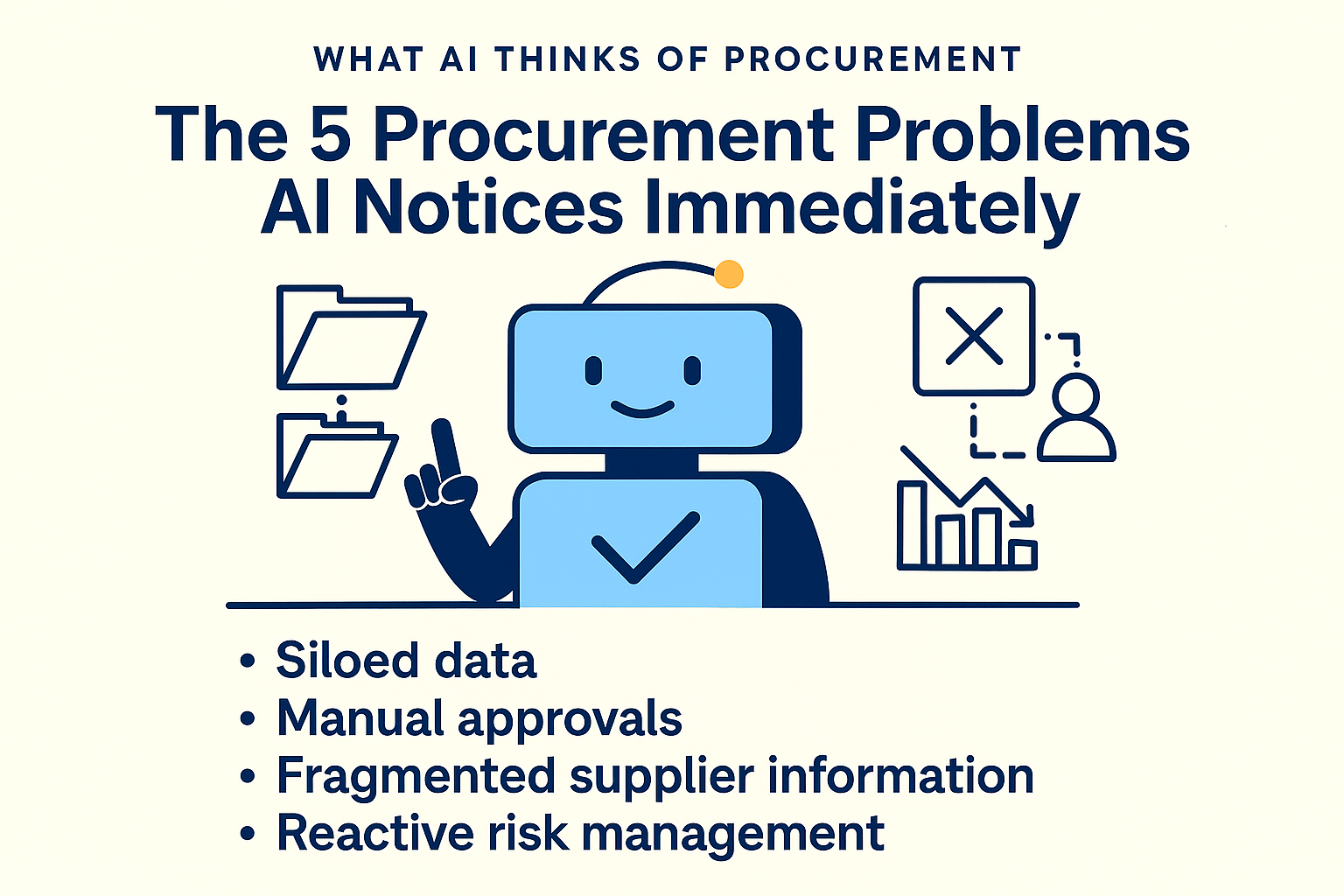
Series: What AI Thinks of Procurement — Post 2
If Post 1 proved anything, it’s that AI sees procurement very differently from humans.
Where humans see “a busy Tuesday,” AI sees patterns, red flags, risk signals, and — occasionally — chaos wearing a polite business-casual outfit.
So today, we let AI sit in the driver’s seat and share the five things it notices the instant it looks at most procurement functions.
You may want to sit down. Or hydrate. Or emotionally prepare.
Let’s go.
1. Siloed Data — AKA: “Why does everyone have their own spreadsheet?”
AI takes one look at procurement data and immediately says:
“Why is the supplier master in 12 places? Why does Finance have a different version? Why is Category Management using a Google Sheet last edited during the Bronze Age?”
Humans call this “siloed data.”
AI calls it “a scavenger hunt with no treasure.”
Here’s what AI doesn’t understand (but humans know too well):
- Systems don’t talk to each other
- Teams don’t talk to each other
- And honestly… no one wants to open that old shared drive folder named “PROCUREMENT_FINAL_v27.xlsx”
AI’s reaction:
“This could all be avoided with integrated data, APIs, or literally anything from this century.”
2. Manual Approvals — AKA: “The approval queue nobody escapes from.”
AI is extremely confused by manual approval chains.
It sees:
- 8 people approving a $300 purchase
- Approvers on vacation until 2049
- A VP approving office chairs even though they have never sat in one
From AI’s perspective, manual approvals create:
- Delays
- Bottlenecks
- Audit nightmares
- And a lot of “Hey, circling back!” emails
AI’s solution?
Automate 70% of approvals and reserve human decision-making for the stuff that really matters, like “Should we sign a three-year SaaS contract?” or “Why did this supplier just double their price without telling us?”
AI’s thought bubble:
“Why are humans approving things they don’t even want to approve?”
3. Fragmented Supplier Information — AKA: “Same supplier, 4 names, 3 IDs, 2 addresses, and 0 consistency.”
If you ever want to see an AI have a meltdown, show it a supplier master file.
It finds:
- Duplicate suppliers
- Different spellings of the same supplier
- Parent companies that no one realized were connected
- Terms hidden in contracts no one remembers signing
And the best one:
One supplier with three different emails, one of which is definitely from 2006.
AI’s suggestion?
“Unify supplier data. Clean it. Normalize it. Then maybe — just maybe — the universe will make sense.”
To AI, fragmented supplier info creates:
- Bad reporting
- Inefficient sourcing
- Unreliable risk assessments
- Endless confusion
To humans, it creates headaches.
To AI, it creates existential disappointment.
4. Reactive Risk Management — AKA: “Everyone waits until something is on fire.”
AI sees risk forming months before it happens.
Humans, however, often find out about risk when:
- A supplier misses a delivery
- A shipment disappears into the void
- A regulatory issue pops up
- Someone says, “Did anyone know this supplier is being sued?”
AI monitors:
- News sentiment
- Performance trends
- Financial signals
- Delivery patterns
- Weather disruptions
- Geopolitical noise
- Industry volatility
Humans monitor:
“Wait… why is this late?”
AI’s critique is that procurement often reacts after risks hit instead of preventing them.
AI’s simple philosophy:
“If you can predict it, you can prevent it.”
Radical, I know.
5. Underutilized Analytics — AKA: “The dashboards are pretty, but no one is using them.”
AI loves analytics.
It’s basically analytics’ biggest fan.
So when AI sees:
- Beautiful dashboards
- Custom reports
- Trend charts
- Category data
- Supplier scorecards
…and learns that nobody checks them?
AI is devastated.
Analytics today are often used like:
- A safety net
- A quarterly report prop
- A “just in case leadership asks” file
But AI wants analytics to be:
- Predictive
- Prescriptive
- Embedded in decisions
- Driving recommendations
- Informing strategies
AI’s feedback:
“Use the data. Trust the data. Stop printing the dashboards — I made those interactive on purpose.”
Final Thoughts: AI’s Procurement Pep Talk
To summarize what AI sees instantly:
- Siloed data → “Why is everything everywhere?”
- Manual approvals → “Let the robots help, please.”
- Fragmented suppliers → “One supplier, many identities.”
- Reactive risk → “Predict before panic.”
- Underutilized analytics → “You have the answers — use them.”
AI isn’t judging.
Okay, maybe a little.
But mostly, it sees how close procurement is to transforming into a high-performing, insight-driven, strategically fearless machine.
And if AI could leave procurement with one final note, it’d be this:
“The problems aren’t permanent — but the opportunities are endless.”
Leave a Reply